Later in the afternoon, after the cool down back home, the moment of reflection required several consecutive spins of “Wrapped” by Bruce Robison. An incredible album released in 1998 that features Bruce and his brother Charlie, as well as a cast of incredible musicians and songwriters such as Kelly Willis, Lloyd Maines, Rich Brotherton, Mark Patterson, Jim Lauderdale, and Martin Muse, “Wrapped” proclaims oh so succinctly the timeless Texas Hill Country sound. With the Robison boys hailing from Bandera, Texas, their musical roots spread deeply in that creative soil. Music played loudly on the heels of an excursion into the many intriguing corners of the Chihuahuan Desert decompresses my thoughts and helps me make some sense of what I have just seen.
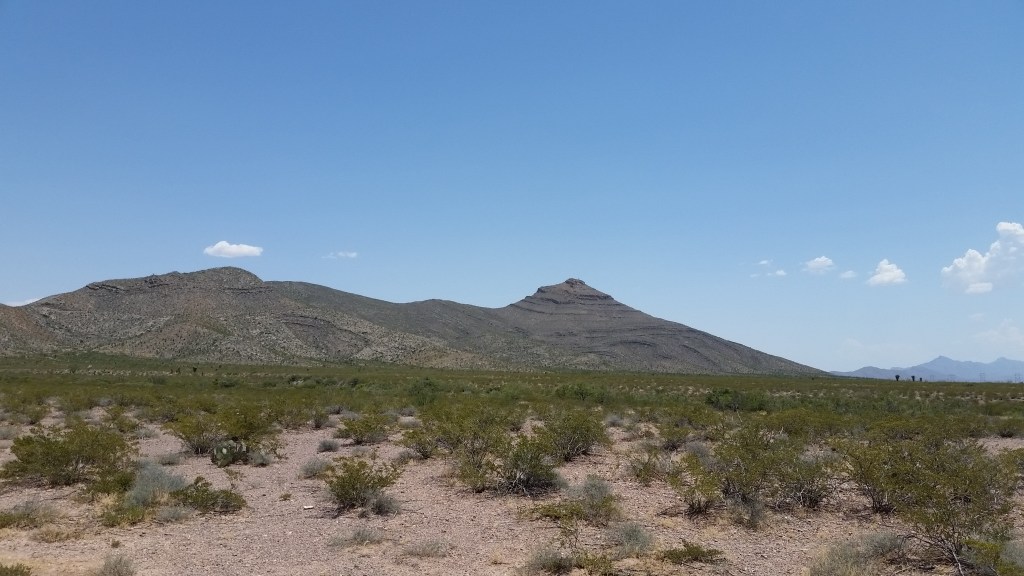
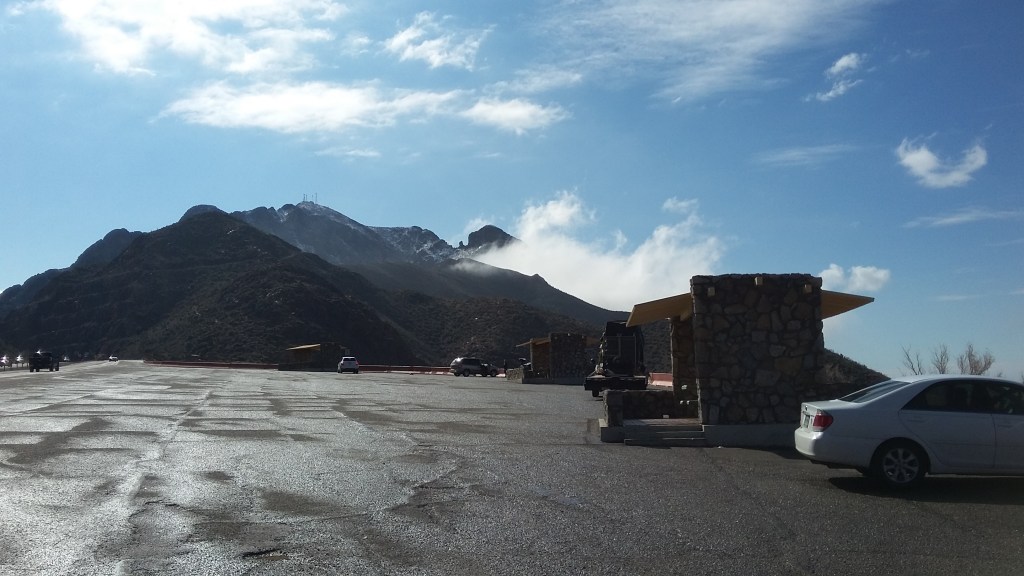
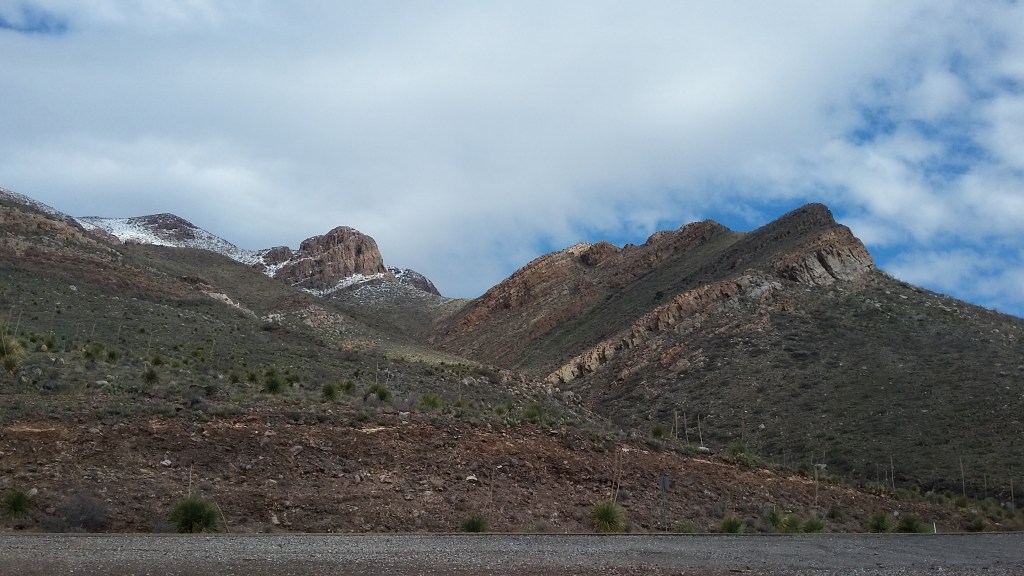
Today I made a memory. Nada mas, pues, para mi, es muy importante. After calling the work week a done deal, our eleven-year-old son accompanied me on a short drive south of Las Cruces to have a look around at an interesting stretch of the Organ Mountains. Short of the Texas line by about three or four miles, the southern end of the Organs disappears under the earth to create the Anthony Gap, that sort of proverbial feature in many Westerns where the good guys head off the bad guys just as lampooned in “Blazing Saddles,” and although the gap is relatively wide, some short distance to the south the uplift begins anew in a mighty fashion that bears the name of the Franklin Mountains.


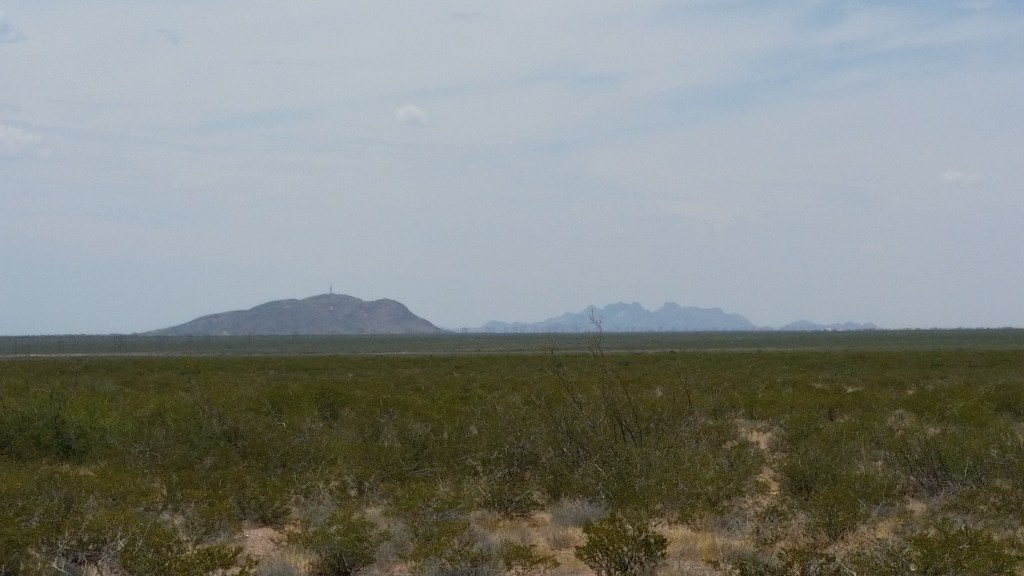
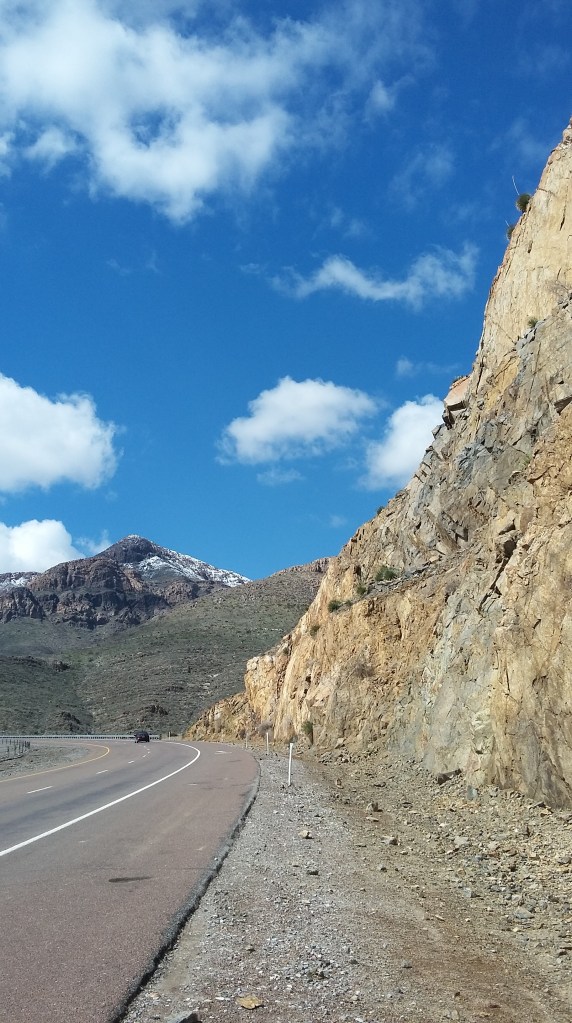
The Franklins, like their nearby, northern neighbors run along a north-south axis, and curiously Nineteenth Century U.S. military cartographers portrayed the Organs and the Franklins as one continuous range rather than two. But it ain’t so. Tectonics and ancient geology have had their say, despite what Man thinks. Yet those great elemental forces seldom daunt poetic souls. Case in point: if you stand in the middle of Anthony Gap facing to the east—the source of wisdom—and extend your arms in the manner of the lower attitude Leonardo di Vinci articulated in his classic study of proportion, your fingertips would point directly toward two fancifully named geological features. Down the view-line of your right arm rises North Anthony’s Nose, a prominent point demarcating the northern edge of the Franklin Mountains, and when your good eyes gaze along your left arm in the opposite direction your peepers perceive a conical uplift known as Bishop Cap. To your back, that is, to the west, about five miles, courses ye olde Interstate 25 with its many wayfarers zipping by at breakneck speed thoroughly oblivious to the natural beauty surrounding them and ignoring Ferris Bueller’s advice. But there they are, North Anthony’s Nose and Bishop Cap keeping an eye on one another as they’ve done for something like 30 million years … and I doubt either one’s gonna blink anytime soon, as it must be a matter of pride between those two. C’est la guerre, que no?

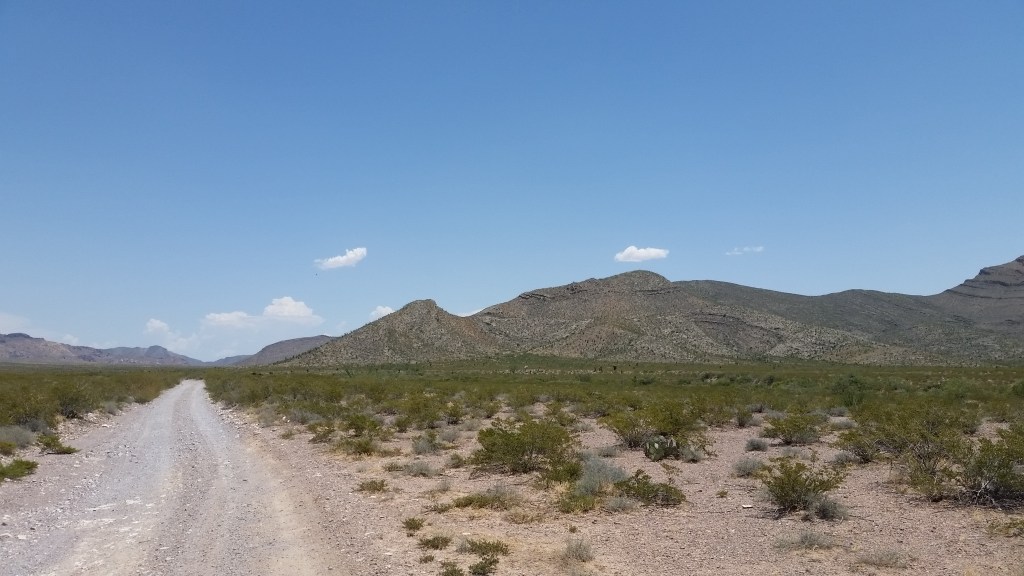
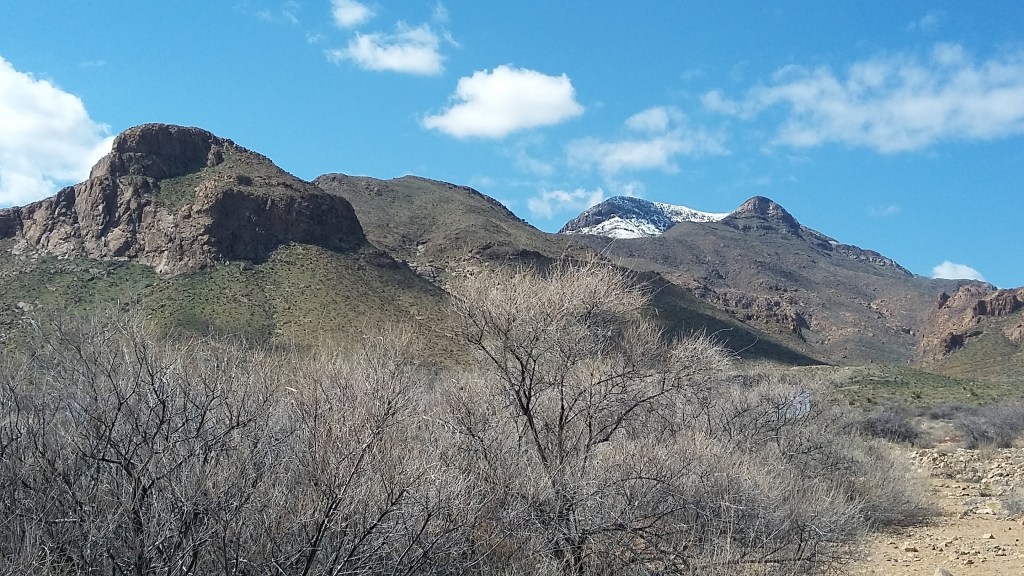
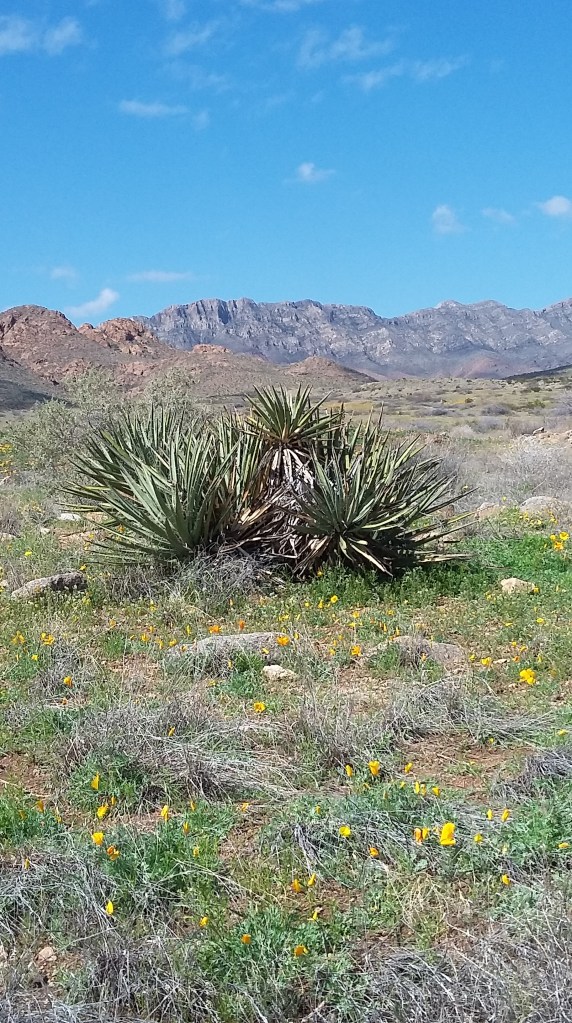
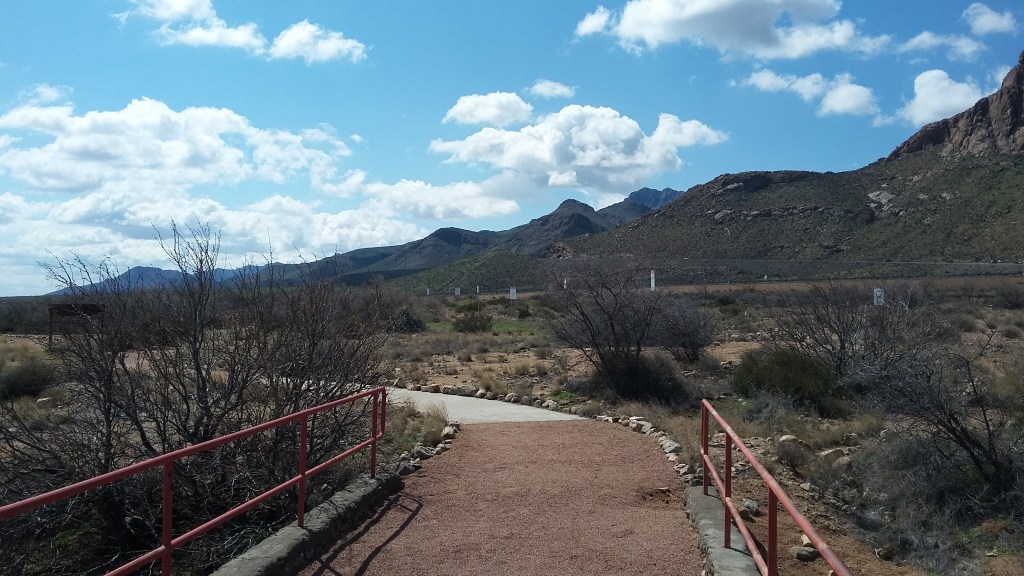
But on this Friday afternoon on the twenty-sixth day of June of the present year, I enjoyed the good honor to spend some quality time with my son out on a little patch of the desert. The temperature was to my liking, pulsing back and forth between 105º F and 106º F, a sparse range that will keep you honest, and skies mostly cloudless and elegantly blue, but my little guy thought otherwise. The desert’s charm didn’t sit with him too strongly despite the enormity of the view before our collective eight eyes. Maybe it was those dang flies that found us and brought great annoyance, or perhaps it was the heat, or it could have been the solitary standing among the ancients that tends to unsettle a soul unaccustomed to such vistas, but at any rate our visit stretched across a brief span of time, yet before we retraced our steps over the narrow, rock-strewn road to the smooth hard-surface leading back to town, we looked around to take it all in. TC noticed two spent 12-gauge shell casings just off the road in the creosote. Neither must have been soaking up the sun there for too terribly long, as both the red plastic and the brass caps showed little signs of weathering. Here and there were some tell-tale signs of off road beer-drinking excursions, but nothing major. So we looked at the dwarf forest of creosote and the lonely hills and talked about the geology of long time and snapped a few pictures to freeze a moment that he and I will talk about some years later and then we hit the road. Well, that’s an inaccurate description. We traveled down the road at a rate that never exceeded seven miles an hour. We were only about a mile from the graded, county road, but for that initial stretch I was cautious not to bottom out the JEB I was driving, because Corollas tend to have low clearance, and there were plenty of rocks that would have loved to rip out its undercarriage. But without damaging the property or pride of Toyota manufacturers, Mr. TC and I successfully made it back to Las Cruces in good shape, a bit worn down by the sun’s heat but overall alright.
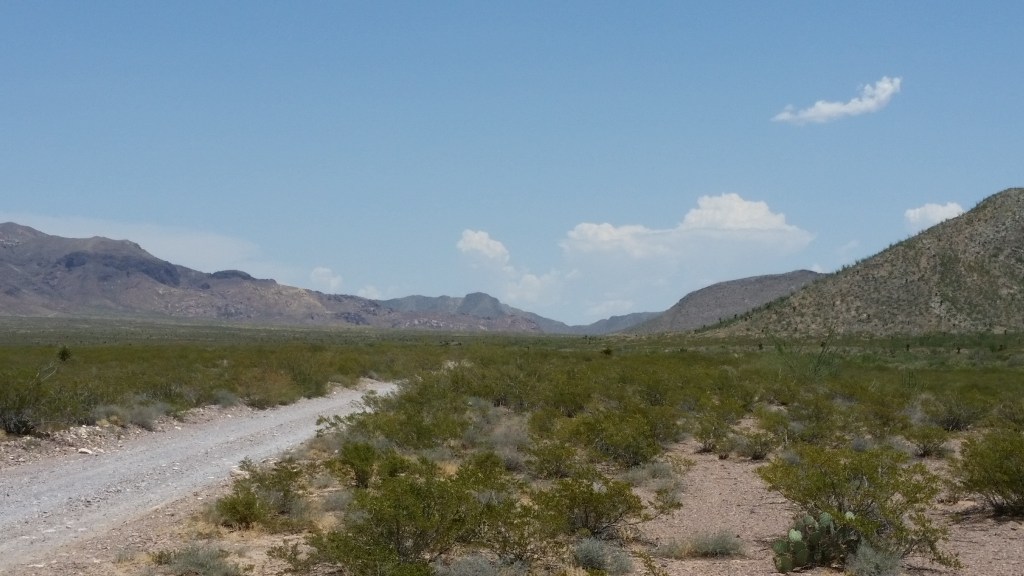

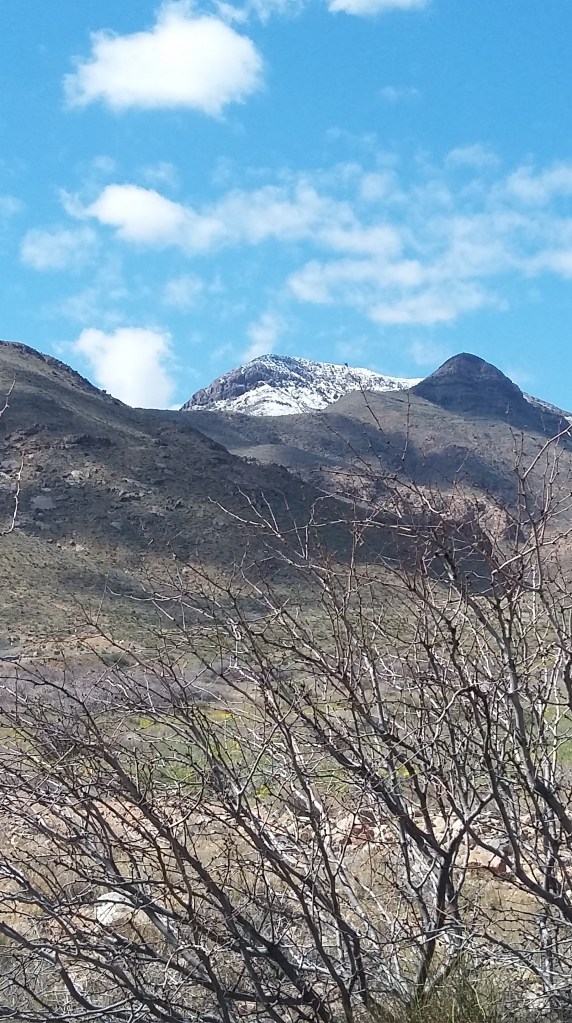
Summer in the Chihuahuan Desert seldom isn’t hotter’n a two dollar pistol, a climate unsuited and uncomfortable for many, which is one of the reasons I have embraced it so well. Out on the range, though, we endured a momentary blue northern; I’ll be damned but if an arctic blast didn’t creep in for a snap and plummet the temperature to a chilly 103º F. To add to our difficulties, as we were driving in and later when we were heading out, with the windows down of course, a bunch of cousins to the common house fly swarmed us. I don’t know if the salt on our forearms from the perspiration drew them or whether they represented some sort of welcoming vanguard to the southern end of the Organ Mountains can only be conjectured, but there we were, looking at the Earth’s shape-shifting from a time before human reckoning. From where we stood by the side of the road, to our right on a southerly angle, rose the peak that upon observation does resemble a liturgical mitre, while to the north a geological blemish wrought by faulting and folding some many, many years ago exposes a three hundred foot tall outcropping known as Peña Blanca. As a sidebar, suffice it to say that the east side of that squat formation features a few caves, and in them archaeologists have found corncobs and bones that dated to the Mogollon culture epoch, which indicates that humans have lived in this territory for many thousands of years.
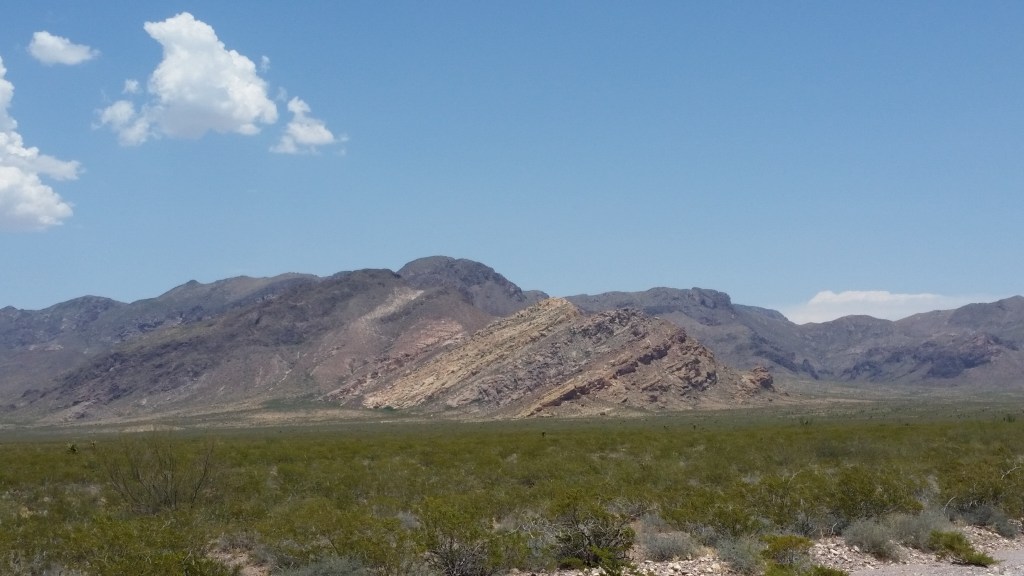
I drove out to this spot while the sun was almost directly overhead, at the beginning of summer in the Chihuahuan Desert, on a day that most reasonable people would seek the comfort and shelter of an air-conditioned, darkened room, and I’m beyond proud that TC wanted to accompany me. Despite the temperature and the bugs, those few minutes standing among the creosote while gazing at the majestic uplifts in the scorching, brilliant sunlight are minutes I will long cherish and appreciate. This land may be tough, no doubt about it, but to stand within it and to appreciate it for what it is, well, those moments do more good for my soul than spending any amount of time drinking at the poison well that is social media. I write about this desolate, inviting land to replenish what the daily grid and all its meanness seeks to take from me. In the same spirit as the great Chris Wall, who’d “rather be a fence post in Texas / than be the King of Tennessee,” I’m very comfortable in anonymity, writing what I need to write, and seeking peace that can only be found outdoors and not on-line. Captain Buffett titled one of his songs “Why the Things We Do,” which appears on the 1989 Off to the See the Lizard album, a record highly esteemed by Darren Elliott of Amarillo, Texas, and rightfully so, and he wrote, “In the driftwood house you learn how to dream / Truth is stranger than fishin’ it seems.” Jimmy’s on to something there, man. He’s on to something good.
Upon spending some time yesterday evening and throughout a good part of this day trying to write and think in between songs by Bruce Robison, Butch Hancock, the Tragically Hip, Toni Price, the Eagles, Led Zeppelin, and others, I’m reminded of the question put to me about the music I select for inspiration during long drives through Arid America. After all, I reference songs, musicians, and albums often, but on his point I’ll have to return to the Son of a Son of a Sailor, who, in 1978 at the Fox Theater in Atlanta chimed in on a request shouted from the audience: “I know that one! We’ll get to it. We’ve got about nine million albums and as many songs, but we’ll get to it!” So I’ll address my own musical question in due time, but for the moment I dedicate these words and their spirit therein to a fellow who was nowhere near Georgia on that night the Coral Reefers were on stage. So, to the great Dr. Leland Turner, better known as Lelando de Vaca, who, by his own account, is the preeminent authority on cattle in the Trans-Pecos and Australia, your compadres ranging from Lubbock to San Angelo to Las Cruces wish you all the best on your birthday! Cat dadddddddddy!!!













 Notes on Arid America